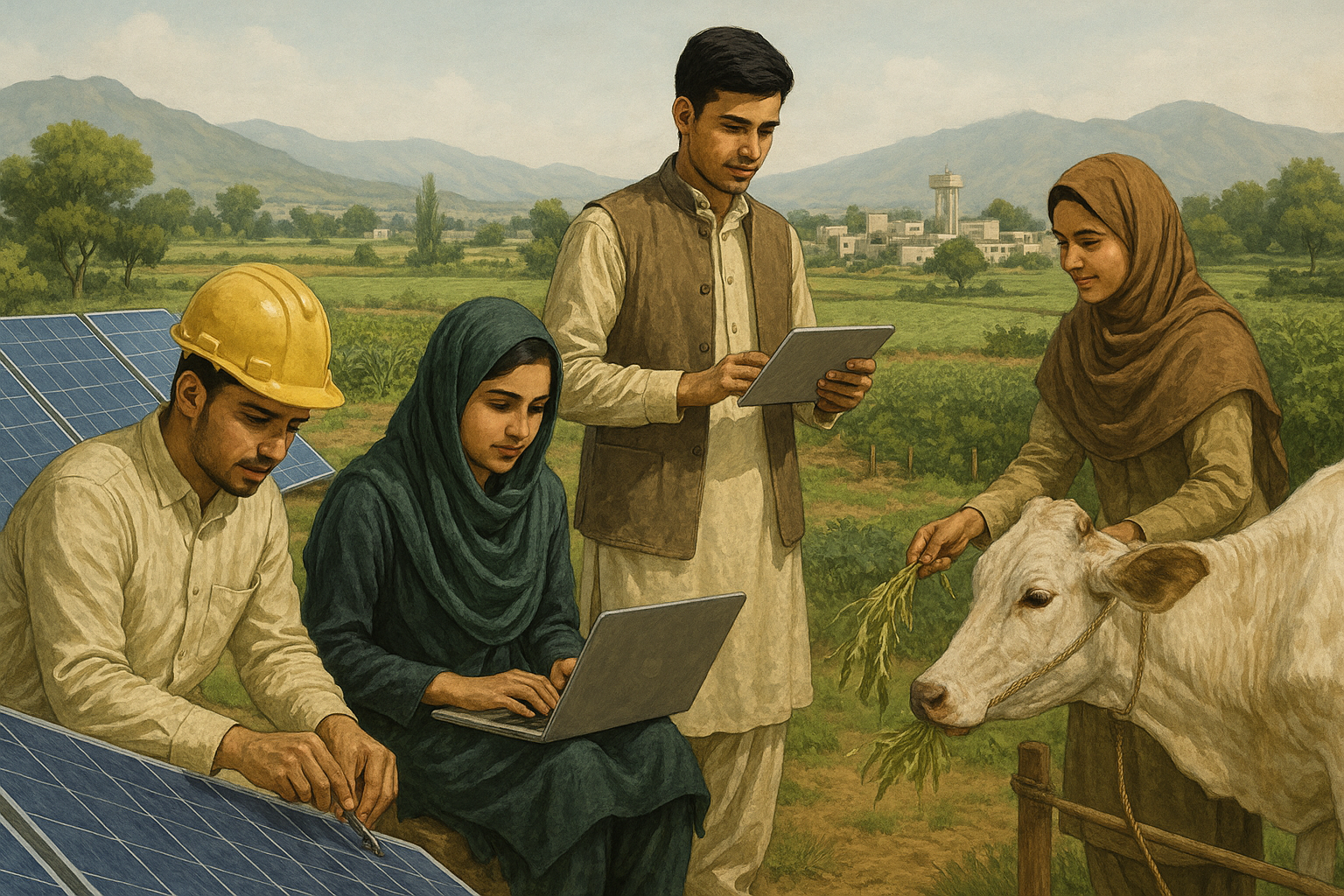
This document presents a district-level analytical assessment of pathways to integrate youth into the green economy and sustainable livelihoods in District Mardan, Khyber Pakhtunkhwa. Developed as a policy-relevant and decision-support resource, it responds to the dual challenge facing the district: a rapidly growing youth population and the urgent need to transition local economic systems toward climate resilience, low-carbon growth, and inclusive employment.District Mardan holds strategic importance due to its demographic profile, agricultural strength, proximity to the Rashakai Special Economic Zone, and strong connectivity to regional and national markets. With nearly two-thirds of its population under the age of 30, the district faces both the risk of prolonged youth unemployment and the opportunity to harness a demographic dividend if appropriate livelihood pathways are identified and enabled. This study situates youth employment challenges within broader structural realities, including skills mismatches, gendered barriers to labor force participation, climate vulnerability, and evolving market demand.The analysis identifies four priority green economy value chains with high potential for youth integration: solar energy and renewable technologies, climate-smart agriculture and agro-processing, the digital economy and IT-enabled services, and livestock and dairy value addition using green practices. These pathways are assessed through a multi-criteria lens that considers employment potential, youth accessibility, environmental contribution, market growth, and feasibility within the district context.Rather than proposing prescriptive projects, the document offers strategic options, entry points, and enabling conditions that can inform government planning, donor programming, private sector engagement, and youth-focused initiatives. By grounding green economy opportunities in local data, institutional realities, and provincial policy priorities, the report aims to support more coherent, scalable, and youth-centered approaches to sustainable economic transformation in District Mardan